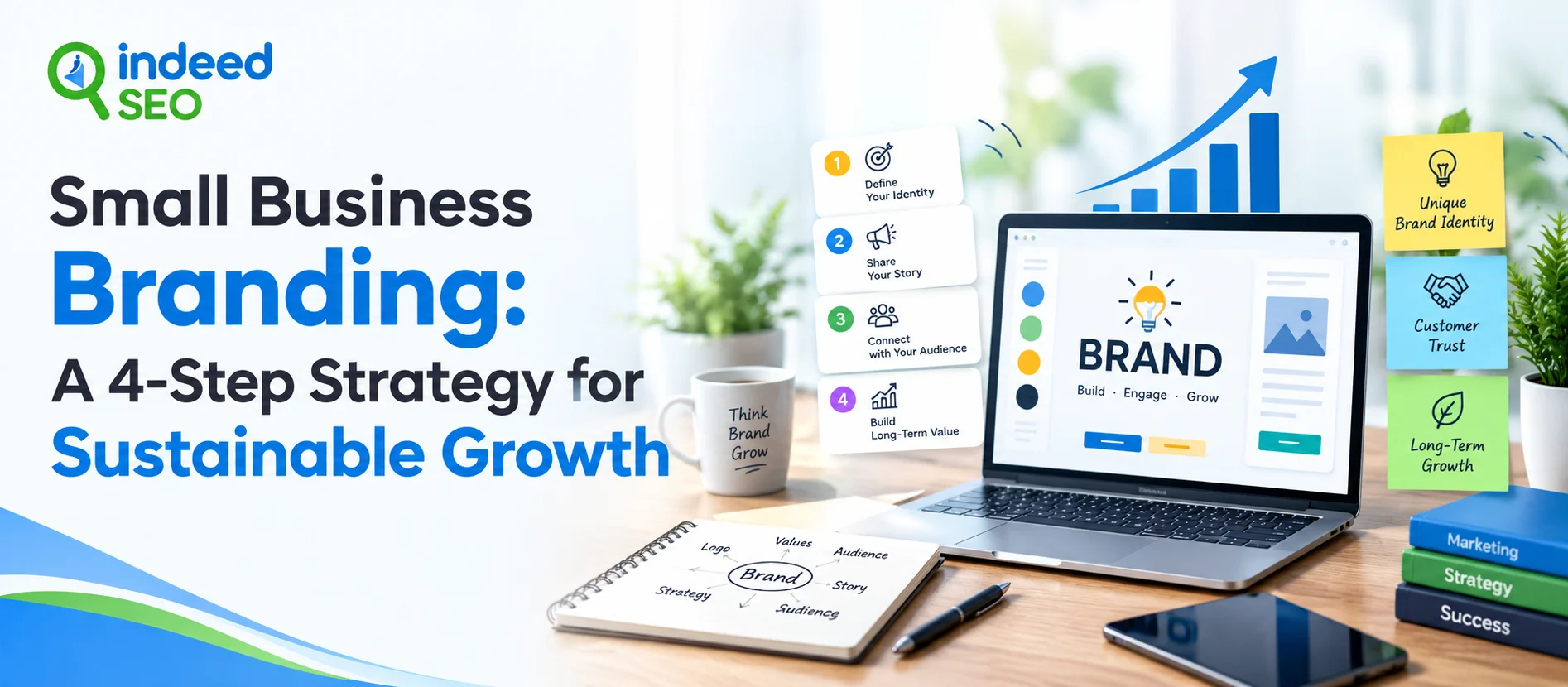
A 4-Step Strategy for Sustainable Growth
A small business branding is a step by step process that involves trust building, message consistency, market awareness, and reducing cost per acquired customer (CAC) while cultivating customer loyalty. Developing strong brand identity for brand will help you convert first-time buyers into loyal customers while simultaneously allowing you to maximize your every marketing dollar.
What Is Small Business Branding?
Branding for small businesses is based on a dual structure comprising a visual brand and a marketing positioning strategy. Visual branding such as logos, color schemes, and fonts are only part of the story. The branding strategy should also include the company’s fundamental principles, communication style, and a USP.
Visual branding leaves first impressions; however, a customer’s memory and trust in your business largely depend on positioning factors. An integrated brand identity ensures that both aspects are synchronized, creating a consistent presence that supports your Top AI SEO Services strategy and helps strengthen your brand’s visibility and credibility.
4 Key Components of an Effective Small Business Marketing Strategy
- Brand Identity & Positioning: A clear and unique Value Proposition (UVP) is the best way to highlight the difference of a brand together with the right graphical style.
- Search Engine & Content Marketing: Creating strong online presence through SEO Services and valuable content is one of the key ways to draw and gain trust from potential customers on the web even before they contact the company.
- Targeted Paid Advertising: Google advertising combined with social media ad campaigns can be very effective in driving rapid lead generation without a heavy reliance on paid promotions.
- Professional Execution & Agency Support: When a business is planning to create an omnichannel presence, they need some very specialized services, which small teams often don’t have in-house.
Developing an omnichannel presence often requires dedicated expertise. Partnering with an experienced team for small business marketing with Copify allows business owners to focus on core operations while scaling their online visibility through tailored SEO and PPC campaigns.
Key Benefits of Investing in Professional Branding
Professional branding significantly contributes to the conversion rates, because consistent messages help establish the level of trust that a customer needs in order to decide to purchase something. It also brings about better ROI from ads as a well-identified brand makes the effect of your paid campaigns much bigger and less expensive with time. Besides the aspect of getting new customers, effective branding helps support customer retention. This saves money that would be used on bringing back the same audience again.
How to Measure Small Business Branding Success
There are three major metrics by which you can measure the success of your branding efforts. At first, it is direct traffic which measures the customers who come directly to your site. Secondly we have a branded search volume which is the number of people who have done Google searches that include the actual business name, and customer lifetime value. CLV at third number is the total revenue that is generated by one regular customer during the period of their time as your customer.
Summary
Branding for small businesses is a well-defined and measurable plan, it is certainly not only the logo part. When it is properly executed, it reduces the cost of acquiring customers, improves the effectiveness of advertisements, and even more, it leads the company in sustainable, long-term growth.
PakarPBN
A Private Blog Network (PBN) is a collection of websites that are controlled by a single individual or organization and used primarily to build backlinks to a “money site” in order to influence its ranking in search engines such as Google. The core idea behind a PBN is based on the importance of backlinks in Google’s ranking algorithm. Since Google views backlinks as signals of authority and trust, some website owners attempt to artificially create these signals through a controlled network of sites.
In a typical PBN setup, the owner acquires expired or aged domains that already have existing authority, backlinks, and history. These domains are rebuilt with new content and hosted separately, often using different IP addresses, hosting providers, themes, and ownership details to make them appear unrelated. Within the content published on these sites, links are strategically placed that point to the main website the owner wants to rank higher. By doing this, the owner attempts to pass link equity (also known as “link juice”) from the PBN sites to the target website.
The purpose of a PBN is to give the impression that the target website is naturally earning links from multiple independent sources. If done effectively, this can temporarily improve keyword rankings, increase organic visibility, and drive more traffic from search results.